


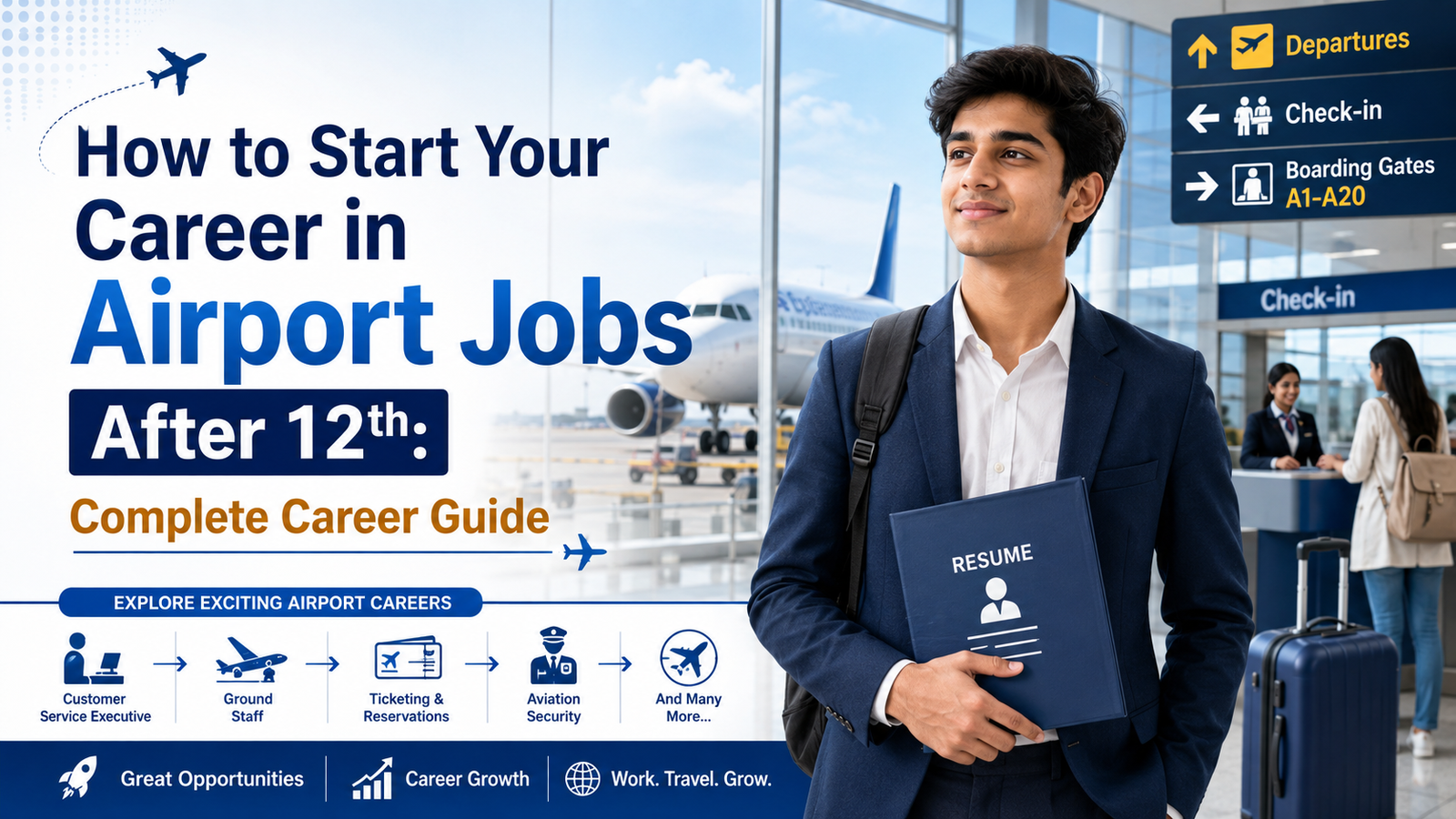
Completing your 12th standard is an important milestone, but choosing the right career path after school can sometimes feel confusing. If you are interested in aviation, customer service, airport operations, travel, or working in a professional and fast-paced environment, airport jobs can be an attractive career option.
The aviation industry offers several entry-level opportunities where candidates with a 12th-pass qualification may be eligible to apply. Depending on the position, employers may also look for good communication skills, basic computer knowledge, professional behaviour, and job-specific training.
This guide explains how you can prepare for airport jobs after 12th and build a strong foundation for a career in the aviation industry.
Can You Get an Airport Job After 12th?
Yes. Several airport and airline-related positions may accept candidates who have completed their 12th standard.
However, eligibility is not the same for every position. Requirements can vary depending on the airline, airport operator, ground handling company, contractor, location, and nature of the job.
Candidates should always check the official job notification before applying.
Some entry-level opportunities may include:
Airport Ground Staff
Passenger Service Executive
Check-in Executive
Customer Service Executive
Baggage Handling Staff
Ramp Support Staff
Cargo Operations Assistant
Ticketing and Reservation Executive
Airport Retail Staff
Hospitality Staff
Airline Customer Support Executive
Airport Operations Support Staff
Certain technical, security, supervisory, or specialised positions may require additional qualifications, licences, certifications, training, or experience.
Step 1: Understand Different Airport Job Roles
Before applying for airport jobs, understand what each position actually involves.
Ground Staff
Ground staff support passengers and airline operations at the airport. Their responsibilities may include passenger assistance, check-in support, boarding coordination and handling general passenger queries.
This role can be suitable for candidates who enjoy interacting with people and have strong communication skills.
Passenger Service Executive
Passenger service executives help travellers throughout different stages of their airport journey.
Their responsibilities can include:
Assisting passengers at check-in counters
Providing flight-related information
Helping during boarding
Supporting passengers with special requirements
Responding to customer queries
Good communication, patience and customer-service skills are important for this position.
Baggage and Ramp Operations
Ramp and baggage teams support aircraft ground operations.
Depending on the position, responsibilities may involve baggage movement, coordination with operational teams, equipment handling and other ground-support activities.
These roles may be physically demanding and can involve working in shifts.
Cargo Operations
Airports also handle large volumes of domestic and international cargo.
Cargo-related roles may involve:
Documentation
Shipment coordination
Cargo movement
Data entry
Warehouse support
Communication with different operational teams
Candidates interested in logistics and operations may consider this career path.
Ticketing and Reservation
Ticketing and reservation executives help customers with bookings, flight information, itinerary-related queries and reservation support.
Basic computer skills, communication ability and attention to detail are particularly useful in these roles.
Step 2: Check the Eligibility Criteria
One of the most important steps is checking the eligibility requirements before submitting an application.
For many entry-level positions, employers may look for:
Educational Qualification
Candidates may be required to have completed 10+2 or an equivalent recognised qualification.
Some positions may require graduation or additional professional qualifications.
Age Requirement
Age criteria depend on the employer and position. Always verify the minimum and maximum age mentioned in the official recruitment notification.
Communication Skills
Airport environments involve interaction with passengers, colleagues and operational teams.
Good communication skills in Hindi, English and/or regional languages can be beneficial depending on the position and location.
Basic Computer Skills
Knowledge of computers can be useful for jobs involving passenger information, documentation, ticketing, reservations, email communication or data entry.
Medical and Physical Requirements
Certain operational positions may have specific medical, fitness, eyesight or physical requirements.
These requirements vary according to the nature of the job.
Step 3: Develop the Skills Required for Airport Jobs
Your educational qualification helps make you eligible, but your skills can make you a stronger candidate.
Focus on developing the following areas:
Communication
Learn to communicate clearly and professionally.
Practice:
Introducing yourself confidently
Speaking clearly in interviews
Answering customer questions politely
Communicating professionally over phone and email
Customer Service
Airports serve thousands of passengers with different needs every day.
Candidates should learn how to:
Remain calm under pressure
Listen carefully
Handle complaints professionally
Help passengers politely
Find practical solutions to problems
Professional Behaviour
Punctuality, teamwork, discipline and professional conduct are important in aviation-related workplaces.
Basic Computer Knowledge
You should be comfortable with:
Email
Basic typing
Web browsers
Documents
Spreadsheets
Online forms
More specialised systems can usually be learned during training or after joining, depending on the employer.
Step 4: Consider Aviation Training if Required
Aviation or airport-related training can be useful for candidates who want to understand the industry before applying.
Courses may cover areas such as:
Airport operations
Passenger handling
Aviation terminology
Customer service
Ground handling basics
Ticketing concepts
Communication
Interview preparation
Professional grooming
However, candidates should understand that completing a private aviation course does not automatically guarantee an airport job.
Always research the institute carefully before paying course or placement-related fees.
Check its course structure, trainers, student reviews, fee policies and whether any placement claims can be independently verified.
Step 5: Create a Professional Resume
Your resume is often the first thing a recruiter sees.
For a fresher, keep it clean, simple and ideally limited to one or two pages.
Your resume can include:
Personal Details
Full name
Mobile number
Professional email address
City or current location
Career Objective
Write two or three lines explaining the type of opportunity you are looking for.
For example:
“Motivated 12th-pass candidate seeking an entry-level opportunity in airport operations or passenger service where I can use my communication, teamwork and customer-service skills while building a long-term career in aviation.”
Education
Include:
Class 12 qualification
School or board
Passing year
Relevant additional qualifications
Skills
You can mention skills such as:
Communication
Customer service
Basic computer knowledge
Teamwork
Problem solving
Time management
Language proficiency
Training or Certification
Mention any genuine aviation, computer, communication, hospitality or customer-service certification you have completed.
Do not include skills or qualifications that you cannot demonstrate during an interview.
Step 6: Prepare for the Airport Job Interview
Interview preparation can significantly improve your chances of performing confidently.
Recruiters may ask questions such as:
Tell me about yourself.
Why do you want to work at an airport?
Why are you interested in the aviation industry?
What are your strengths?
How would you handle an angry passenger?
Are you comfortable working rotational shifts?
Are you willing to relocate if required?
How would you handle a stressful situation?
Why should we hire you?
Instead of memorising answers word-for-word, understand what you want to communicate and practise answering naturally.
Step 7: Work on Your Professional Presentation
For customer-facing airport positions, professional presentation can matter.
For an interview:
Wear clean and formal clothing
Keep your hairstyle neat
Wear clean footwear
Maintain good personal hygiene
Avoid excessive accessories
Carry your documents in an organised folder
Reach the interview location on time
Professional grooming does not mean looking fashionable. It means appearing clean, organised and suitable for a professional workplace.
Step 8: Apply Through Genuine Recruitment Channels
This is one of the most important parts of your airport job search.
Whenever possible, check vacancies through:
Official airline career websites
Official airport operator websites
Verified ground-handling company career pages
Established recruitment portals
Official recruitment notifications
Verified company social-media accounts
Before submitting documents or money, verify who is recruiting you.
Be Careful of Fake Airport Job Offers
Airport and airline jobs are popular, which unfortunately also makes them attractive targets for recruitment scams.
Be cautious if someone:
Guarantees a job without an interview
Demands a large payment for appointment letters
Contacts you using suspicious email addresses
Pressures you to transfer money immediately
Claims to represent an airline but cannot provide verifiable information
Asks for sensitive personal or banking information unnecessarily
Sends unofficial-looking offer letters without a proper recruitment process
Always independently verify recruitment information through the concerned organisation's official channels.
A genuine-looking logo, ID card, WhatsApp message or appointment letter alone does not prove that an offer is authentic.
Step 9: Keep Your Documents Ready
While applying or appearing for an interview, you may need documents such as:
Updated resume
Recent photographs
10th marksheet/certificate
12th marksheet/certificate
Government-issued identity proof
Address proof, where required
Training certificates, if applicable
Experience certificates, if applicable
The exact document requirements will depend on the employer.
Never hand over original documents permanently to an unknown recruiter.
Step 10: Start Applying Consistently
Getting your first job can take time.
Do not depend on only one application.
Create a simple routine:
Check genuine vacancies regularly.
Read the eligibility criteria carefully.
Apply only when you meet the requirements.
Keep your resume updated.
Practise interview questions.
Improve your communication skills.
Track the jobs you have applied for.
Follow official recruitment updates.
Consistency can make a major difference during your job search.
Career Growth in Airport Jobs
Your first airport job does not necessarily define your entire career.
With experience, strong performance and additional skills, employees may move toward senior responsibilities.
A possible career progression may look like:
Passenger Service Executive → Senior Executive → Supervisor → Team Leader → Duty/Operations Role
or
Cargo Assistant → Cargo Executive → Supervisor → Senior Operations Role
Actual designations and promotion structures differ between companies.
Employees can also move into other areas of aviation, hospitality, travel, customer experience, logistics and operations as they gain experience.
Skills That Can Help You Grow Faster
If you want to build a long-term aviation career, continue improving your skills even after securing your first job.
Focus on:
Spoken English
Professional communication
Leadership
Computer knowledge
Customer handling
Conflict resolution
Aviation operations knowledge
Time management
Team coordination
Your attitude, discipline and willingness to learn can be just as important as your initial qualification.
Ready to start your airport career?
Register for the online examination or talk to our counsellors today.


